Polonnaruwa served as the second capital of ancient Sri Lanka, flourishing between the 11th and 13th centuries CE. Unlike the sprawling ruins of Anuradhapura, Polonnaruwa's main attractions are concentrated and offer a fantastic glimpse into a golden age of architecture, art, and hydraulic engineering, particularly under the reign of King Parakramabahu I.
Rise to Glory: The Parakramabahu Era
Polonnaruwa initially rose to prominence after the decline of Anuradhapura. Its peak occurred during the 12th century under King Parakramabahu I, who commissioned spectacular construction projects, famously declaring, "Let not even a drop of water that falls on the land, flow into the sea without being utilised." This era saw the creation of immense reservoirs (including the Parakrama Samudra) and magnificent palaces and temples.

The ruins of the Royal Palace were once a massive seven-story structure.
The Artistic Crown Jewel: Gal Vihara
The Gal Vihara (Rock Temple) is the most celebrated monument in Polonnaruwa. It features four magnificent Buddha statues carved directly into a single massive slab of granite. These include a large reclining Buddha (14m long), a seated Buddha, and a standing figure. They are widely regarded as being among the best examples of ancient Sinhalese rock carving and Buddhist art.
The Sacred Quadrangle and Massive Stupas
The Sacred Quadrangle is a compact, elevated area containing the most concentrated collection of Polonnaruwa's ancient structures. Key sites here include the Vatadage (circular relic house), the Thuparama, and the Hetadage. Just north of the Quadrangle stands the towering Lankatilaka Image House, a massive brick structure with thick walls and a colossal headless Buddha statue. Further north, you'll find the impressive circular Kiri Vihara stupa, one of the best-preserved monuments.
The Wonders of Parakrama Samudra
Polonnaruwa's engineering genius is best exemplified by the man-made reservoir, Parakrama Samudra (Sea of Parakrama). This massive tank provides irrigation to the dry zone fields and once served as the city's water supply. The scale of this ancient project is immense, highlighting the advanced hydraulic knowledge of the Sinhalese kings, who valued self-sufficiency in agriculture.
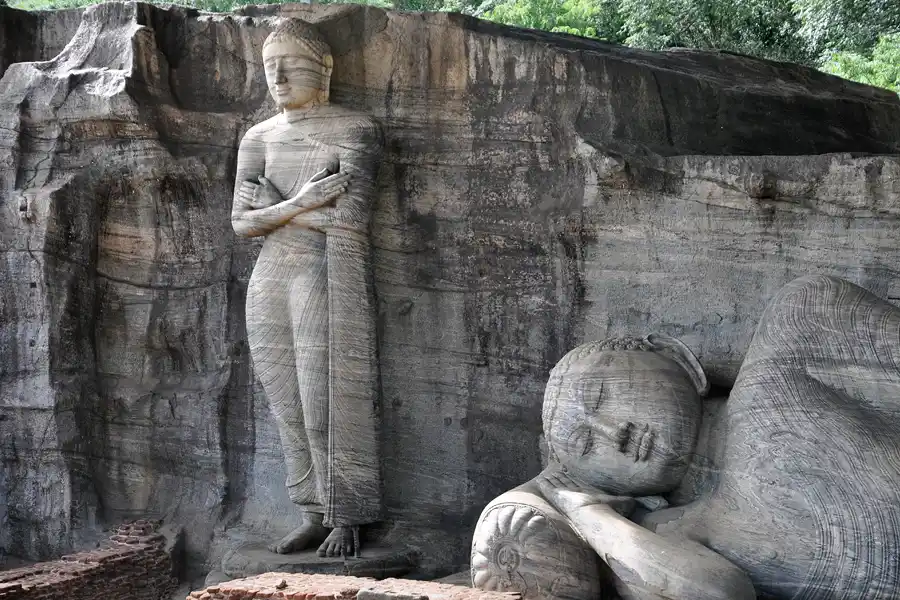
The beautifully carved reclining Buddha statue at Gal Vihara is a highlight of the site.